



Truck and Bus Brake Hoses: Heavy-Duty and Bulk Supply
Release Time:
Aug 27,2026
A truck hydraulic brake hose is not a car hose scaled up. The bore has to be bigger, the expansion data has to be checked, and bulk buying works differently when you supply a fleet. What changes at 6.3 mm, and what to ask before a bulk order.

A truck hydraulic brake hose is not a car hose scaled up. Make the line longer, add axles, add weight, and the fluid circuit changes shape. The two decisions that matter on commercial vehicles: bore size, and how you buy the hose. Both change at 6.3 mm.
Bore size is the first decision
A bus or truck brake circuit moves a lot of fluid. Multi-axle systems and longer lines, heavier calipers on top. A 3.2 mm line that works on a sedan does not feed that circuit.
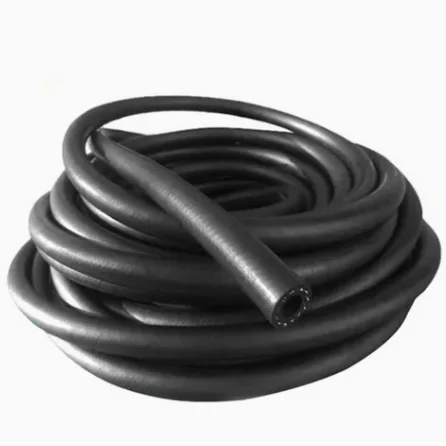
Our commercial grade 6.3 mm (1/4 inch) hose exists for exactly this. It moves more fluid per pedal stroke than the 4.8 mm (3/16 inch) heavy duty line that suits SUVs, MPVs, and light trucks. The rule of thumb: match the bore to the circuit, not to the vehicle class. A light commercial van on 4.8 mm is fine. A bus with multi-axle circuits needs the bigger bore.
Expansion is the trade-off, and this is where most buyers stop reading too early. At 6.9 MPa, the 6.3 mm hose expands 2.69 ml/m; at 10.3 MPa, 3.84 ml/m. The 4.8 mm line measures 1.81 and 2.36 ml/m at the same two pressures. The bigger bore gives up more volume to expansion, proportionally, and stays within SAE J1401 limits. Those are the numbers to compare, not the outer diameter.
What heavy-duty construction means
The construction does not change much between 4.8 mm and 6.3 mm. What changes is the margin.
Both lines use an EPDM inner tube, a dual-layer synthetic fiber braid, and an ozone-resistant EPDM cover. Both are rated for DOT3 and DOT4 fluid, and for -48°C to +120°C. The 6.3 mm line carries a minimum burst pressure of 50 MPa; the 4.8 mm line, 60 MPa. A lower burst number on the bigger hose is not a quality drop. It is the wall, thinner over a larger bore, and 50 MPa still leaves a margin far beyond anything a road brake circuit will see.
Certification matters more on commercial stock. The hose is certified to SAE J1401 and GB16897, and the fitting threads are standard commercial sizes: M10×1.0, M12×1.0, 3/8-24 UNF.
Bulk supply changes the buying
Fleet buyers do not buy one hose. They buy by the roll, or by the scheduled batch.
The 6.3 mm line is supplied in bulk rolls for workshops and assembly lines that crimp in-house, or as finished assemblies with fittings and lengths specified at order. Fleet pricing and scheduled delivery are part of the offer, and planned delivery cadences can be matched to a maintenance cycle. For a fleet with scheduled brake work, that is a real saving: the hose arrives when the service bays are ready for it, not in one oversized shipment.
Two cautions. Crimping in-house saves money only if the crimp is right, so ask for the crimp spec before you buy a roll. And compare expansion at both pressure points, not just the burst number. The bore gets you flow; the expansion data tells you what the pedal feels like.
Ask your supplier for
- Expansion at 6.9 MPa and 10.3 MPa for the exact bore you are buying, not a one-line "low expansion" claim.
- The minimum burst pressure, stated as a test value.
- Bulk roll and finished assembly options, with the crimp specification for in-house work.
- Fleet pricing tiers and a delivery cadence matched to your maintenance schedule.
- Certification documents for the batch: SAE J1401 and GB16897.
FAQ
Is a bigger bore always better on a truck?
No. Bigger bore moves more fluid, but expansion grows with it. The 6.3 mm hose expands more than the 4.8 mm at the same pressure, proportionally, within SAE J1401 limits. Pick the bore that feeds the circuit, then check the expansion data. A hose too big for the application is a soft pedal waiting to happen; one too small is a slow one.
Can we buy bulk roll and crimp in-house?
Yes, and it is a common setup for distributors and assembly lines. The saving depends on the crimp. A bad crimp fails at the fitting, not in the hose run, so ask the supplier for the crimp specification and pull test data before you commit to a roll.
What does fleet pricing actually change?
Two things: the unit price and the delivery schedule. Scheduled delivery matched to a maintenance cycle means the stock is not paid for months before it is used, and service bays are not blocked waiting on freight.
Why does the 6.3 mm hose burst at 50 MPa when the 4.8 mm does 60?
Wall thickness and bore. The construction is the same; the geometry is not. Both numbers are minimums, and both leave far more margin than any road brake circuit will use. Compare expansion and burst together, not burst alone.
Need truck and bus brake hoses in bulk rolls or as finished assemblies? We supply both, with fleet pricing and scheduled delivery. See our truck and bus brake hose assemblies and 4.8 mm heavy duty brake hose assemblies, or send your annual volume forecast for a fleet quotation.
Key words:
News Hotspot




Contact Us