



Brake Hose Crimping: What the Order Line Never Says
Release Time:
Oct 20,2026
An assembly order line can be complete in every field the buyer has a box for and still leave out the step where the joint is decided. A crimp specification belongs to a hose, a fitting, a die and a machine as a combination, not to the hose alone. This guide walks one order line through the specification, the two settings inside the ferrule, the test that actually measures the joint, and the reason a warehouse crimp leaves nothing to audit.

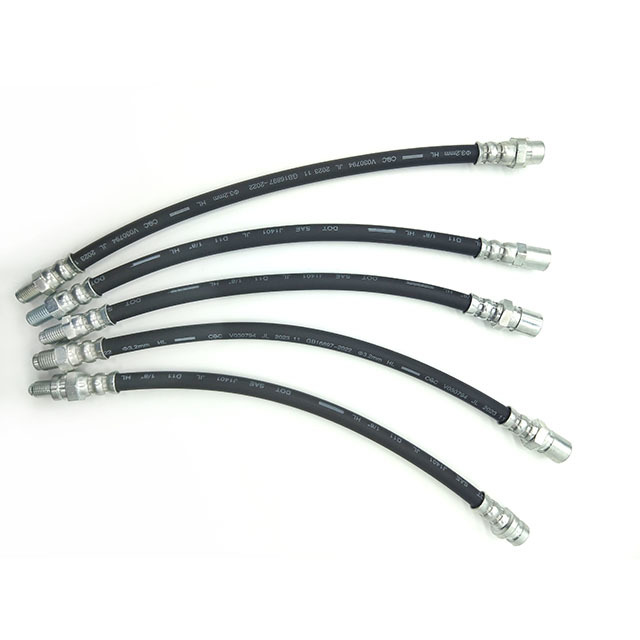
A brake hose assembly order line can be complete in every field the buyer has a box for. Bore. Outside diameter. Length. Thread on both ends. Batch and date code. Nothing on that line says how the end fitting is attached to the hose, and that is the step where the part is made rather than supplied.
The specification belongs to a combination
A crimp specification is not a property of a hose. It is a property of a combination: this hose, this fitting, this die, this machine. Gates defines it as the exact parameters that join a hose and a coupling for a leak-free connection. Kuriyama's crimping guide is written against a named hose and coupling range rather than a universal table. Both point at the same limit. Change one element of the combination and the specification that covered the old combination says nothing about the new one.
The hydraulic range makes the arithmetic visible. Three bores, 3.2, 4.8 and 6.3 mm, run across four outside diameters: 9.0, 10.5 ± 0.2, 12.5 ± 0.3 and 15 ± 0.4 mm. Four outside diameters mean four ferrule sizes before a fitting series has been drawn into the picture.
So a purchase order that reads "SAE J1401 assembly, 3.2 mm, 600 mm, M10 × 1.0 both ends" has described the hose and the fittings. It has not described the joint. Who holds the crimp specification for that combination, and on which machine it was validated, are two questions the order never asks.
Crimp diameter and insertion depth, read together
Two settings live inside the ferrule, and neither means anything alone.
The first is crimp diameter, how far the die closes. Closed too far, the die bites into the reinforcement. Closed too little, the hose walks out under pressure. Neither condition shows on the outside of a finished assembly. Both look like a ferrule.
The second is insertion depth, how much hose sits inside the ferrule. That length is the seal path. A shallow insertion gives a short seal and puts the stress riser at the ferrule mouth, which is where a weep starts eight months later.
A 4.8 mm build shows why the two cannot be quoted apart. That line runs a 12.5 ± 0.3 mm outside diameter over a 3.85 mm wall. The wall is what the ferrule compresses. It is not the crimp diameter, and a quote offering wall thickness as evidence of a controlled joint has answered a different question.
One more figure worth keeping in its own box: the shop works to a fabrication accuracy of ± 0.1 mm. That describes how the hose is made. It is not a crimp tolerance, and an order line should not accept it as one.
What burst pressure does not touch
Burst is the number most purchase orders quote, and it measures the reinforcement: 80 MPa across most 3.2 mm builds, 70 on one 3.2 mm build, 60 on the 4.8 mm, 50 on the 6.3 mm.
In a burst test the reinforcement gives first. The ferrule is not the specimen under load. That is why 49 CFR 571.106 carries the joint as its own requirement instead of folding it into burst, and why a burst report cannot stand in for a joint report. A batch can clear 80 MPa and still leave the dock with a ferrule nobody measured.
The pull test, and the seventy hours before it
571.106 asks that a hydraulic brake hose assembly, after 70 hours of water immersion, withstand a pull of 325 lb without the hose separating from its end fitting, the requirement set out in 49 CFR 571.106.
Read the order of that sentence. The immersion comes first. A dry pull is a different test on a different specimen, and a report quoting a pull figure without saying whether the sample was conditioned has told you half of what the number means.
The conditioning is not ceremony. Water reaching the interface between hose and ferrule changes the friction the joint relies on, and it gives corrosion a start that a plated fitting exists to delay. A joint with margin passes both conditions. A joint built to the edge of its specification passes dry.
So when you ask about the joint, ask for this figure with its condition attached, not for the crimp diameter. The diameter is an input the factory controls. The pull is the output you are buying.
Why a field crimp leaves no evidence
Bulk hose, loose fittings and a bench crimper is a normal arrangement on the distribution side, and it is where the chain breaks.
Redhorse Performance prints the rule on its own crimp-on brake hose ends: do not crimp brake lines by hand, and the ends must be used with a professional grade crimping machine. Even with a good machine, three things are missing in a warehouse. The die that matches the fitting series. A specification validated for that exact hose and fitting combination. A record written after the crimp was made.
None of the three can be reconstructed from a finished assembly. You can measure a crimp diameter on any bench and still not know whether it was the right diameter for that ferrule, because the answer sits in a document that was never written.
This is where two checks get confused. A 96-hour salt spray on the fitting finish tells you the coating will survive the coast. It says nothing about whether the ferrule was closed to the right diameter. One is a coating test, the other is a process record, and a shipment can carry the first while missing the second.
Our own assemblies are crimped in-house, which is the reason the question has an answer here at all: the specification, the die and the pull figure sit in the same building as the press.
Target values for the next assembly order
Eight lines, and a quotation template usually has a field for six of them. The two it misses are the two that decide whether the joint holds: who owns the crimp specification, and what the pull figure was after the soak.
Bring us the order line you are working from and the fitting written on it, and we will tell you which crimp specification applies. The factory brake hose assembly range lists the builds, custom length assemblies cover the cut lengths, and the commercial grade range is at jzhose.com.
FAQ
Does SAE J1401 cover how the ends are attached to the hose?
It states performance requirements for the assembly, not the manufacturing recipe behind it. The crimp specification is a factory document held by the maker, and the two are not the same thing. A hose that conforms to the standard can still leave a plant where nobody can produce the specification for that hose and fitting combination, which is why the validation record is worth requesting separately from the certificate.
Can we crimp brake hose assemblies ourselves with a bench crimper?
Only if three things exist: a die matched to the fitting series, a specification validated for that exact hose and fitting combination, and a record written after the crimp. Miss one and the joint carries no evidence chain. The printed position in the trade is blunt about the hand version, and it applies to a bench without tooling control just as well. If the volume does not justify the tooling, buy finished assemblies rather than rebuild them in a warehouse.
What should I ask for to prove the joint is sound?
The pull figure with its condition attached: 325 lb after 70 hours of immersion, with no separation, as 49 CFR 571.106 requires. Then the fitting combination, the batch and date code, and the 96-hour salt spray on the fitting finish. Four items, and the crimp diameter is not one of them. A diameter can be measured on any bench. Only the first item tells you what that diameter was supposed to be.
Key words:
News Hotspot




Contact Us