



Brake Hose Inspection Checklist: Six Checks Before You Sign
Release Time:
Oct 21,2026
A delivery note asks for one signature. Six checks belong in front of it, and each one is tied to a document rather than to a habit. Carton label against invoice. Outside diameter and wall against tolerance. Thread gauges against the callout. Marking and date code against the batch report. The report line that answers a joint question. The crimp record for assemblies. A check with no document behind it is a conversation, not evidence.

A delivery note asks for one thing, which is a signature. Everything that decides whether a short shipment, a wrong build or an untested batch becomes your problem or the supplier's has to happen before that signature.
Six checks do the work. They run in a fixed order, each one against a document, and the order is set by what gets expensive first. A count that is wrong while the truck is still at your dock is a phone call. The same count discovered after the driver leaves is a claim.
The inspection starts with the carton label
Count the cartons and read the label before any carton is opened. The label carries quantity, supply form and size mix. The invoice carries quantity and price. Compare those two first.
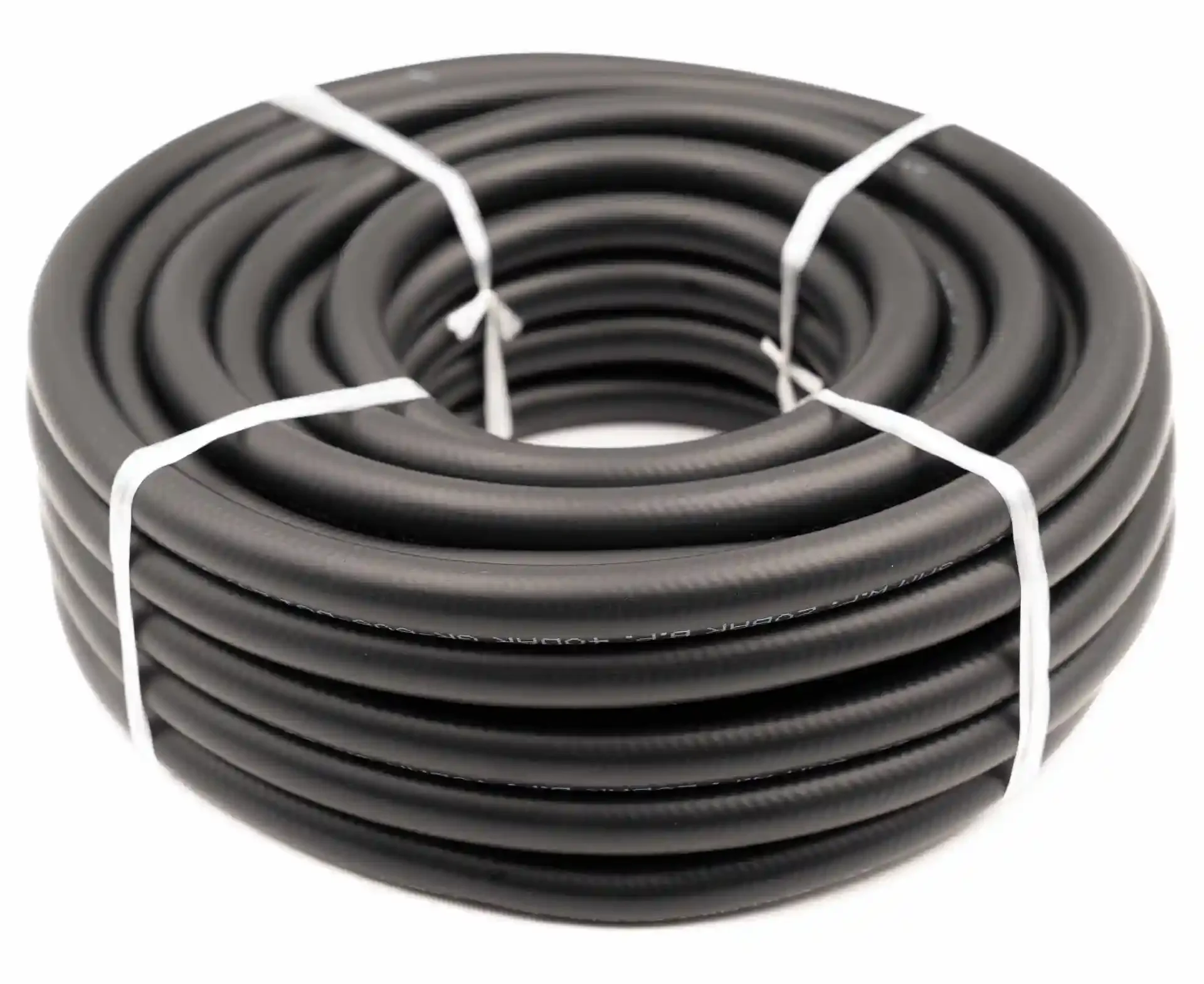
Supply form is the field that gets skipped. A coil and a cut length are not interchangeable at receiving: a coil is opened, measured and re-packed, while a cut length goes against a drawing. Whichever the order says is what the label should say, and the two disagree more often than the count does.
The size mix earns its own line because the product family looks alike at arm's length. Three bores, 3.2, 4.8 and 6.3 mm, run across four outside diameters of 9.0, 10.5 ± 0.2, 12.5 ± 0.3 and 15 ± 0.4 mm. Two builds can share an end and differ in the wall, which is why the label has to be read with the carton still closed and the split plan in hand.
Measure the outside diameter and the wall
Caliper readings go on the record, three points per sample, ninety degrees apart, at a marked distance from the end. The number on the sample is compared with the tolerance band on the order, not with the number the supplier quoted last year.
A reading inside the band is not the same as a reading on target. A 10.5 ± 0.2 mm callout accepts 10.3 and 10.7 mm, and to a ferrule those are two different hoses. The wall makes the difference visible: 2.92, 3.65 and 3.85 mm all sit under the same small bores, and a fitting that was validated on one wall is not automatically valid on another.
One number that should not be used here is the fabrication accuracy of ± 0.1 mm. That is a shop figure describing how the hose is made. It is not a receiving tolerance and does not replace a measured value.
Threads need a gauge, not a nut
M10 × 1.0 and M10 × 1.25 both start on the same stud. One threads two turns and stops. The other feels tight, runs in further than it should, and damages the thread it is meant to seal against.
A nut from the bench proves neither case, because a nut that has been used on the same fitting for years has already taken the shape of that thread. Go and no-go gauges, one pair per thread callout on the purchase order, and a result recorded per carton.
This is the check that gets skipped when the fittings look right, and it produces the most expensive returns, because a wrong thread is usually found at installation, after the vehicle is on a lift with the system open.
Three documents, one batch
A hydraulic hose carries a marking with brand, standard and bore. The carton carries a batch number and a date code. The test report carries a batch number. Three documents, one batch.
If the report's batch cannot be found on any carton in the shipment, the shipment is untested as far as your records go, whatever the report says. If the carton's date code sits months away from the hose marking, the batch has been repacked or mixed, and the report no longer describes what is in the box.
Traceability earns its cost six months later, when one line on one vehicle starts weeping and the question is whether it came from this shipment. Without the three documents agreeing, that question has no answer, and the discussion moves from evidence to opinion.
The report has to answer the question you will ask
For hydraulic assemblies, two lines carry the weight. The first is the pull figure after conditioning: 325 lb after 70 hours of immersion, with no separation, the requirement set out in 49 CFR 571.106. A pull figure without its conditioning stated is half a number.
The second is the salt spray hours on the fitting finish, if the order claims 96 hours. Coating life and joint integrity are separate questions, and a report that answers the first should not be read as answering the second.
A burst figure alone covers neither. Burst measures the reinforcement, and the figures run 80, 70, 60 and 50 MPa across the builds. A carton can clear its burst line and still carry a joint nobody measured.
A product certificate is not a substitute either. A certificate says a product family was qualified at some point. A batch report says what happened to this carton.
Assemblies: length, angle and the crimp record
Three more items apply once the order is for finished assemblies rather than hose.
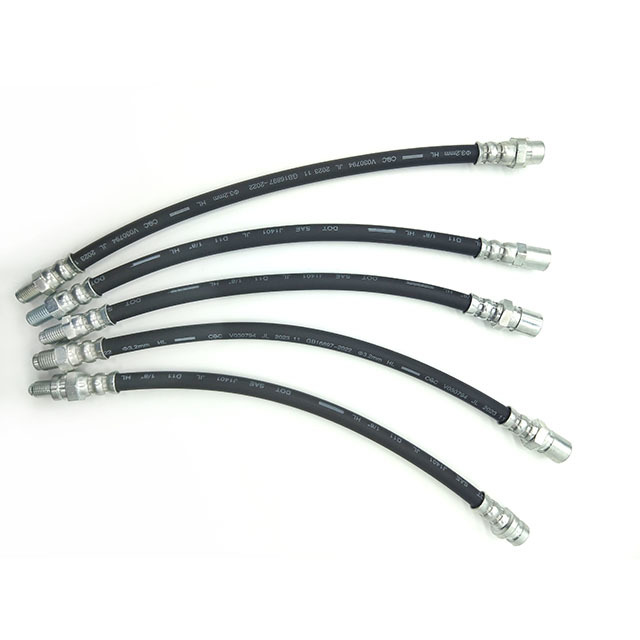
Overall length goes against the drawing, measured along the hose and not across the bends. A length that is 5 mm long fits nothing, and the error is only visible with the part on a bench.
Banjo angle goes against the drawing too, because a fitting clocked thirty degrees off routes the hose into the suspension instead of around it, and no amount of correct length fixes that.
The third item is the crimp record: who crimped it, on which die, and what the pull figure was for that batch. Without it, a joint that fails in month eight cannot be argued in either direction, and the buyer carries the doubt. Our own assemblies are crimped in-house, which is the reason the record can travel with the carton instead of being reconstructed afterwards.
Six red lines, and what each one costs if you sign anyway
- The carton count and the invoice count disagree. Sign nothing until both are counted again with the driver present, because after he leaves the shortage is yours.
- Two or more samples measure outside the tolerance band. Refuse that carton rather than the pallet, so the claim stays specific.
- Any fitting fails the go gauge. Reject the carton, since a mixed pallet is exactly where a wrong thread hides.
- The report's batch number appears on no carton. Treat that batch as untested and ask for the report that matches the box.
- An assembly report shows burst and no pull figure. Ask for the missing line before signing, because burst cannot cover a joint.
- An assembly arrives with no crimp record. The joint has no history, and the first failure will be settled by negotiation rather than by evidence.
A signature is a statement that you checked. Six checks, one page, and the claim stays a supplier question instead of becoming your liability.
If the order involves cut lengths or fittings that are not on the standard list, send the drawing with the enquiry. The factory brake hose assembly range covers the standard builds, custom length assemblies take the drawing route, and the commercial grade range sits at jzhose.com.
FAQ
Do I have to open every carton at receiving?
No. Count every carton and sample by carton. Opening becomes justified when the count or the label disagrees, or when a sample fails a measurement. Keep the sample point in the same position on every carton so the readings can be compared across the shipment.
Is a product certificate enough instead of a batch report?
A certificate covers a product family. A batch report covers the carton in front of you. Receiving needs the second one, and the difference is only paid for on the day something goes wrong.
What if the fault appears a month after I signed?
Then the argument turns on the three documents. If the marking, the carton batch and the report agree, the batch can be identified and the discussion stays technical. If they do not, the shipment cannot be tied to a report, and the claim becomes a matter of goodwill.
Key words:
News Hotspot





Contact Us