



Brake Hose Assembly Drawing: Five Fields Before a Quote
Release Time:
Oct 22,2026
Three quotes for the same assembly, three different prices. Before blaming the factory, read the sheet that went out: length without a datum, an angle without a reference face, a thread without a pitch, marking without a position, and a test callout that names a standard but no acceptance number. Each gap is filled in differently by every supplier who quotes, and the spread in the quotations is the spread in their assumptions.

Three quotations arrive for the same brake hose assembly and the prices sit nowhere near each other. The usual next step is to question the factories. The cheaper first step is to read the sheet that was sent out.
A drawing that leaves a field empty does not stop the quoting process. It delegates the missing decision to whoever quotes, and each supplier delegates it differently. Five fields carry most of that delegation, and all five can be closed before the file leaves your desk.
Length means nothing until the datum is on the sheet
End to end, or along the curve? Including the fittings, or hose only? Three readings of the same physical part, and the difference between two of them can exceed the tolerance that the drawing spends a paragraph defending.
A hose measured along its curve is longer than its end-to-end distance. On a line with a bend in it, the two numbers can differ by more than the cutting tolerance, which means a supplier quoting from one reading and a supplier quoting from the other are pricing different parts.
The cut lengths we quote run from 200 to 1500 mm, and within that band the datum is the only thing that makes two quotes comparable.
Tolerance belongs in the same sentence. The shop holds ± 0.1 mm as its fabrication accuracy, so a drawing that asks for tighter than that needs a process conversation before a price, not after. A supplier who quietly accepts an impossible tolerance has decided to absorb the risk somewhere, and that decision shows up later as a deviation request or a rejected batch.
A banjo angle needs a reference face, not a direction
"Forward" and "downward" are not measurements. A banjo that has to sit at a particular clock position needs an angle and a starting face: measured from the banjo's own axis, or from a flat on the fitting, with the rotation direction stated as seen from the port.
The arithmetic is unforgiving. A standard hex has six flats, sixty degrees apart, so an error of one flat is sixty degrees, not five. A hose clocked sixty degrees off still bolts up, still passes a pressure test on the bench, and routes itself into the suspension the first time the wheel turns.
Length cannot compensate for this. A longer hose clocked wrong is still routed wrong, and the extra length turns into a loop that rubs.
M10 is a diameter, not a thread
M10 exists in at least two pitches, 1.0 and 1.25, and both will start on the same stud. One threads home and seals. The other feels tight, runs in further than it should, and damages the thread it was meant to seal against.
A drawing that says M10 has described half of a joint. It needs the pitch, and it needs to say which end carries which: master cylinder side and caliper side are separate callouts, and they are frequently different on the same assembly.
Metric is not universal either. Some applications use UNF threads, so a drawing that assumes metric because the vehicle is European or Japanese is guessing. The rule we apply on the shop floor is simple: the thread comes from the drawing or from a measured sample, never from the model name.
Marking: say whose name, and where it sits
Marking requirements arrive as a sentence in the remarks field, which is where they get lost. A hose marking needs three things settled: the brand string, the standard text, and the bore. On top of that, it needs a position, because a marking printed where the ferrule will cover it is a marking nobody can read.
For private label, the exact string matters. Case, spacing and punctuation are set by the customer, and a supplier who reformats a brand name has produced a nonconforming carton even if every hose inside is correct. Put the string on its own line in the drawing, not inside a paragraph of notes.
The bore values that most often need stating are 3.2, 4.8 and 6.3 mm. A marking that omits the bore turns every carton into a sorting job at the receiving bench.
Test lines: name the number, not the standard
"Complies with SAE J1401" is a claim about a family of requirements. It is not an acceptance criterion, and an engineer quoting from it has nothing to price against.
Name the line and the number. For assemblies, the joint is proved by a pull figure: 325 lb after 70 hours of immersion, with no separation, as 49 CFR 571.106 sets it. For the hose itself, burst is a figure per build, running 80, 70, 60 and 50 MPa across the range, so a drawing that asks for 80 MPa on a 6.3 mm build is asking for something the build does not carry.
If the order claims a coating life, write the hours: 96 hours of salt spray, not "salt spray tested". A number in the drawing becomes a line in the report. A standard name becomes a discussion.
Six questions the drawing should answer before it leaves
Work through these before the file goes out. Each one has a yes or no answer, and a no is cheaper to fix now than at the deviation stage.
- Where is zero on the length, and does the number include the fittings?
- Which face is the banjo angle measured from, and in which direction does it rotate?
- What pitch is on each end, and what is the evidence for it?
- Whose name goes on the hose, in what exact string, and at what distance from the fitting?
- Which test lines are required, at which acceptance numbers, per batch or per shipment?
- Who owns the tolerance when the drawing asks for tighter than the process holds?
A drawing that answers all six produces quotations that describe one part. A drawing that answers three produces three parts at three prices, and the argument about which one is right starts after the tooling is paid for.
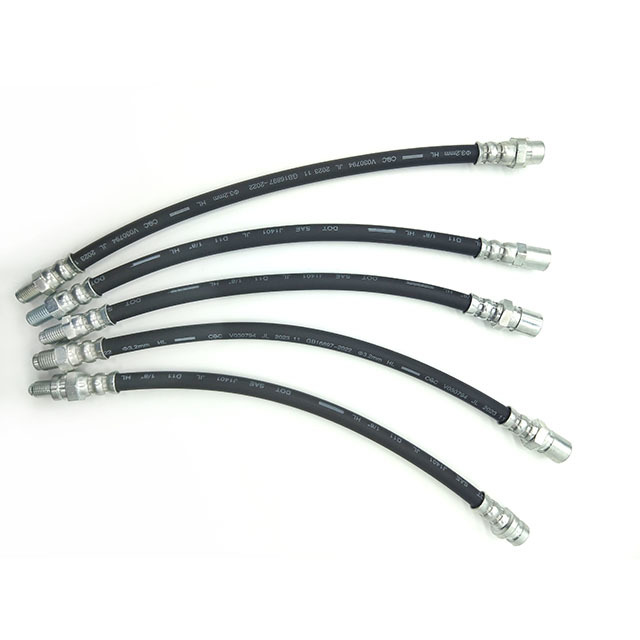
Send the sheet with the enquiry, and send the sample if the thread is uncertain. The factory brake hose assembly range covers the standard builds, custom length assemblies take the drawing route, and the commercial grade range sits at jzhose.com.
FAQ
Can I get a quote from the vehicle model and year alone?
Not a comparable one. A model and year locate roughly which hose is meant. Without length datum, clocking angle and thread pitch, every supplier fills the gaps from a general part, and the three prices you receive are three different guesses.
Why does the supplier keep asking which end a thread is on?
Because the same assembly often carries different threads at each end, and the thread has to match the port, not the hose. Stating one thread for both ends guarantees at least one wrong callout on assemblies that are not symmetric.
What tolerance should I put on the drawing?
Start from what the joint needs, then check it against the process. The shop holds ± 0.1 mm. A requirement tighter than that is worth a conversation before the quotation, because a supplier who accepts it silently has priced a risk rather than a part.
Key words:
News Hotspot





Contact Us