



Hydraulic Brake Hose Recall: What 30,064 Cars Show
Release Time:
Oct 23,2026
A hydraulic brake hose recall expanded to 30,064 vehicles because the original population was drawn on two assumptions: climate exposure and a production window. Field reports arrived from outside both. The part had been in production since February 2021, and an optimized hose entered series production on November 29, 2024, yet the decision to widen the recall came 665 days later. This is a case about records, not about one supplier.

A public filing is a rare thing in this trade: a complete, dated record of how a hydraulic brake hose behaved in the field, what the manufacturer knew, and when it knew it. This one is worth reading closely, not for the failure itself but for the months of scoping that followed.
What the filing puts on the record
NHTSA recall 26V638 covers 30,064 vehicles from model years 2022 through 2025, across six variants of one sedan platform. The largest group is 16,881 units of one all-wheel-drive model; the smallest is 947 units of a Maybach variant. The filing estimates that 100 percent of the population carries the condition.
The component is a front brake hose, part number A2234201800. The build window runs from February 2, 2021 to November 28, 2024, and the manufacturer states that an optimized hose entered series production on November 29, 2024, the day after that window closes.
The remedy is a free replacement at authorized dealers. Dealers were notified on October 9, 2026, and owner letters are scheduled for November 27, 2026. The filing carries no do-not-drive or park-outside instruction.
Two details matter for anyone who buys hose rather than cars. First, the population was determined from production records, not from a parts catalogue. Second, an estimated 100 percent defect rate means the question is not which vehicles are affected, but which vehicles are not.
The boundary was drawn on two assumptions
The original campaign, filed on February 24, 2025, defined its population using climatic exposure and a specific production period. At the time, reported cases sat inside both.
Between March and August 2025, the manufacturer received reports from markets outside the United States. Some involved vehicles built outside the original production range, and operated outside the climate regions the first population was built on. That is the moment a recall stops being a production problem and becomes an investigation.
The investigation ran on a schedule that is worth seeing in full:
- November 2025 to February 2026: a field engineering activity was planned to collect hoses from vehicles showing the condition
- March 2026: the activity launched
- June 2026: collected hoses were returned and sent to the supplier for analysis
- July 2026: the supplier's laboratory and durability results were reviewed
- September 25, 2026: the manufacturer determined that a safety risk could not be ruled out and decided to expand
In the expanded population, three reports are dated April 2, May 29 and August 10, 2026. The filing states no crashes, injuries or property damage are known in that group.
Read as a method, this is unremarkable and correct: you collect parts, you test them, you decide. Read as a timeline, it explains something buyers rarely price in. The gap between a field signal and a decision is not idle time. It is the cost of building evidence.
Why a hydraulic brake hose can pass its tests and still leak
The filing's own language is specific. Affected hoses might not meet durability specifications because of material fatigue, and that fatigue accumulates from increased thermal and mechanical stresses sustained over the vehicle's lifetime.
That is not a description of a bad batch. It is a description of a life. A qualification record answers whether a design meets a set of defined tests at a point in time. A durability target asks how the same design behaves after years of heat cycles and flexing. The two are different questions, and a datasheet can only answer the first.
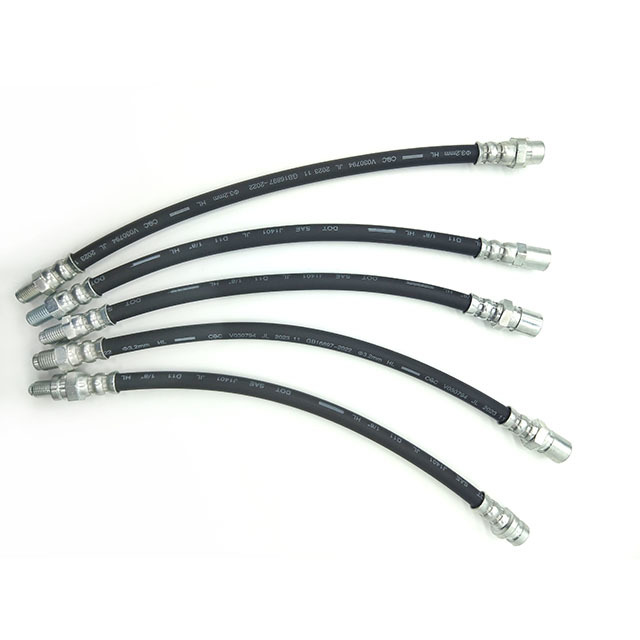
What a datasheet can state is a window. Ours, for the 3.2, 4.8 and 6.3 mm hydraulic brake hose, is a working temperature range of minus 48 to plus 120 degrees Celsius, with minimum burst of 80, 70, 60 and 50 MPa across the range. Those numbers define the envelope a part is qualified against. None of them predicts the ten-thousandth heat cycle, because no bench in a qualification programme runs that long.
The filing also notes that drivers get no warning before a leak develops. A red brake fluid warning may appear once fluid escapes, which places the signal after the event. A leak in one of two circuits leaves braking available, degraded, and easy to postpone.
Nothing in the record suggests the design was unusual. That is exactly why the case is useful: ordinary parts fail on the long tail of ordinary use.
665 days between the production fix and the decision
The optimized hose went into series production on November 29, 2024. The decision to expand the recall came on September 25, 2026, which is 665 days later, and 578 days after the first campaign was filed.
For a buyer, that interval has a practical reading. A production fix does not retroactively describe the field. Vehicles built before the change keep circulating for years, and the only way to bound them is data that points at individual units: a date code on the part, a build record, a report that ties a test to a batch.
Where those identifiers exist, an investigation can be scoped in weeks. Where they do not, the scope defaults to the widest population anyone can justify, which is the expensive direction for everyone in the chain.
The gap between the decision and the owner letter is 63 days. Dealers were notified 14 days after the decision. Both are administrative, and both mean the part was known to be affected long before most owners heard about it.
What a buyer can copy from this case
Three habits cost almost nothing and change what you can prove later.
Keep the date code readable. A marking that the ferrule covers, or a carton whose label was replaced at repacking, removes the one identifier that survives the shipping cycle.
Keep the report tied to the batch. A certificate describes a product family; a report with a batch number describes the shipment in your warehouse. If the number on the report cannot be found on the carton, the batch is untested as far as your records go, whatever the certificate says.
Write change notification into the order. A clause that requires notice before a compound, a reinforcement or a fitting source changes is worth more than a paragraph of assurances, because it creates a date you can point to.
Then do the one-week audit. Pull three cartons at random, find the date code, find the batch on the report, and check that the two agree. If one carton fails the chain, the whole shipment is a question rather than an answer.
The same case, as a time account
The account is not dominated by the repair. It is dominated by the scoping: 665 days from a production fix to a population decision, and 63 more days before an owner is told.
A buyer does not need a recall to run the same arithmetic. Ask how long it would take you to answer "which shipments contained this batch" today. If the answer is more than a day, the missing piece is a date code and a report line, and both can go into the next purchase order.
For the builds this question applies to, the factory brake hose assembly range lists the bores and tolerances, custom length assemblies carry batch reports with the shipment, and the commercial range is at jzhose.com.
FAQ
Does this recall mean the hose failed its standard?
No. The filing describes durability, not qualification. A part can pass a defined set of qualification tests and still miss a life target, because qualification tests run for hours and a vehicle runs for years. Reading a durability recall as a standards failure misplaces the problem.
How do I know which batch I am holding?
Three places, one number. The date code sits on the hose marking or the carton label, the batch number sits on the test report, and the packing list should carry both. If the three cannot be made to agree, treat the shipment as untraceable, which is a different and more serious finding than a failed test.
What should go into the next purchase order because of this?
Three lines: change notification before any compound, reinforcement or fitting source change; a date code that stays readable after assembly; and a batch report delivered with each shipment. All three are administrative, and all three are what an investigation would ask for first.
Key words:
News Hotspot





Contact Us